
Music Activities for Children, Music Lessons, Private Music Lessons
What Instrument Is Best for a Child With Autism?
What Instrument Is Best for a Child With Autism?
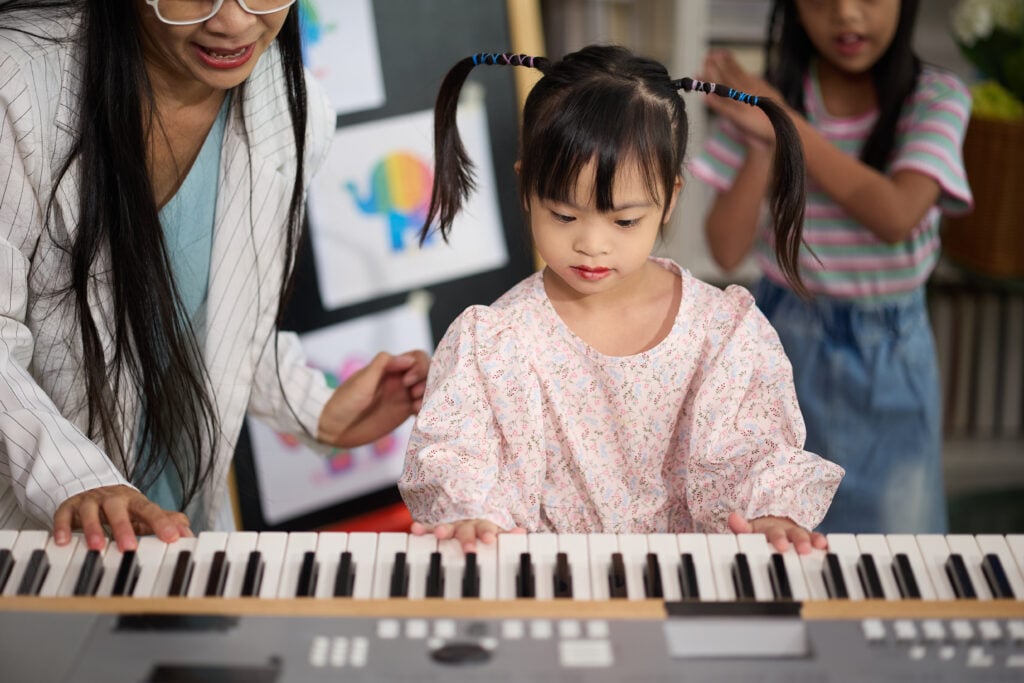
The best instrument for a child with autism is usually the one that fits their sensory preferences, motor comfort, and natural interests. Piano is a common starting point because the keyboard has a predictable visual layout, produces a clear sound with each press, and doesn’t require the child to use their breath or mouth to create a note. Drums, guitar, voice, and violin can also work well, depending on how your child responds to sound, touch, movement, and structure.
Why Does Instrument Choice Matter for an Autistic Child?
Every instrument creates a different combination of sound, vibration, touch, movement, posture, and coordination. A child who finds the violin uncomfortable near their ear may feel completely at home at a piano. Another child may lose interest while sitting at a keyboard but become deeply engaged when playing a drum.
Auditory preferences deserve particular attention. A 2023 study published in Autism Research followed autistic children at ages three, six, and nine. At each age, more than 70% had caregiver-reported auditory processing differences, including sensitivity to sound or difficulty listening in noisy environments.
That doesn’t mean every autistic child dislikes loud sounds. Some enjoy strong rhythmic input, especially when they control it themselves. Paying attention to your child’s individual response can help you choose an instrument and lesson environment they will want to return to.
What Should You Consider Before Choosing an Instrument?
Before choosing an instrument, consider how your child responds to sound, structure, movement, and the physical experience of playing.
1. How Does Your Child Respond to Loud or Sudden Sounds?
Think about how your child responds to hand dryers, vacuum cleaners, crowded rooms, live performances, or sudden noises. Do they cover their ears or move away? Do they enjoy making loud sounds when they know what’s coming?
Control can make a significant difference. A child who dislikes unexpected noise may enjoy pressing a piano key because they decide exactly when the sound begins. Electronic keyboards and drum kits also allow families to lower the volume while the child explores.
2. Does Your Child Prefer Routine and Visual Structure?
Some children feel more comfortable when an activity has a clear order and visible patterns. Piano can be a good match because the keys repeat in the same arrangement, and each action produces a predictable sound.
The lesson itself can also provide structure. A teacher might use the same short warm-up each week or show the child a visual sequence of what they will do. Knowing what comes next can leave more room for the child to focus on making music.
3. How Are Their Fine Motor Skills and Hand Strength?
Different instruments ask different things from the hands. Guitar requires enough finger pressure to hold down strings, while violin involves precise finger placement and bow control. Piano can begin with one finger or one hand before the student works toward more complex coordination.
Current hand strength doesn’t have to rule out an instrument the child loves. A smaller instrument, slower pace, adapted activity, or ukulele instead of a full-sized guitar may make playing more comfortable.
4. Does Your Child Prefer Moving or Staying Still?
A child who enjoys larger movements may connect with drums or percussion, while someone who prefers focused, controlled movements may feel comfortable at the piano or with a string instrument. Voice lessons can also include standing, gestures, and movement instead of requiring the student to remain seated.
If movement, attention, and quick feedback are also important parts of the decision, our guide to choosing an instrument for a child with ADHD explores those factors in more detail.
Which Instruments Work Well for Autistic Children?
There is no instrument designed specifically for autistic students. Each option has qualities that may feel inviting to one child and uncomfortable to another. Watching how your child responds is more useful than choosing according to a general ranking.
Research also cautions against underestimating a child’s musical abilities. In a 2019 study of school-age children, autistic participants performed similarly to non-autistic participants in melodic pitch perception, rhythm perception, and melodic memory. Individual ability still varies, but autism alone doesn’t tell you what a child will be able to learn musically.
Piano
Piano offers a clear visual pattern and an immediate connection between action and sound. A student can press one key and produce a recognizable note without first learning breath control, tuning, or a complicated playing position. They can also play softly, and an electronic keyboard provides even more volume control.
Playing with both hands, reading music, and coordinating several notes can become demanding as the student progresses. Some children may also find sitting at the bench uncomfortable. Piano lessons often suit children who enjoy patterns, visual information, predictable feedback, and structured activities.
Drums and Percussion
Drums turn larger movements into rhythm and give the player immediate feedback. Repeating a beat can feel clear and satisfying, while percussion instruments allow children to explore music before they are ready for detailed note-reading.
Acoustic drums can be loud, and their vibration may feel intense. A full drum kit also requires coordination between the hands and feet. Drums may suit children who seek movement, enjoy strong sensory input, or learn best through physical action. Quieter percussion instruments or an electronic kit can provide a gentler starting point.
Guitar or Ukulele
Guitar and ukulele are tactile, portable, and connected to music many children already enjoy. Learning a few chords can allow a beginner to accompany a familiar song, which may make practice feel relevant from the beginning.
Pressing strings can cause temporary fingertip discomfort, and coordinating the fretting and strumming hands takes practice. These instruments often suit children who enjoy tactile learning, want to play favorite songs, and feel comfortable holding an instrument close to their body. A ukulele may be easier for smaller hands.
Voice
Voice lessons require no separate instrument and can begin with songs the child already knows. Students can sit, stand, move, or use gestures while singing, which may appeal to children who naturally repeat melodies or sing throughout the day.
Singing creates vibration inside the body, which may feel uncomfortable to some children. Listening to pitch corrections, managing breath, or singing in front of another person can also take time. Voice may suit children who love melodies, lyrics, imitation, or expressive movement and already use singing as part of play.
Violin
Violin lessons offer detailed routines, repeated physical patterns, and a close connection between listening and movement. Child-sized violins are available, and some students enjoy the precision involved in gradually improving their sound.
Because the instrument is played close to the ear, its sound may feel intense. It also requires sustained posture, coordinated bowing, and precise finger placement without frets to mark each note.
Violin may suit a child who already loves its sound, enjoys precise tasks, and responds well to repetition. It is often more manageable as a second instrument, although a strong interest in violin may make it the right first choice.
How Can You Set Up Music Lessons for an Autistic Child?
Private lessons are often the easiest place to begin. One-on-one instruction gives the teacher more freedom to adjust the pace, volume, communication style, amount of repetition, and length of each activity. Group lessons may eventually be enjoyable for a child who likes learning alongside peers, but they introduce more voices, sounds, transitions, and waiting.
Consistency can also make the first few lessons more comfortable. When possible, choose the same teacher, time slot, and room each week. A familiar opening activity or simple visual lesson plan can help the child know what to expect.
Some students may benefit from a shorter lesson at first. A focused session that ends while the child is still comfortable can provide a stronger foundation than expecting them to manage a standard lesson length immediately.
Before the first lesson, ask whether your child can see the room, meet the teacher, or look at photos of the space. This removes some of the unknowns before they are asked to participate.
How Can You Tell Whether the Instrument Is a Good Fit?
Signs that the instrument and lessons are working may include:
- Your child shows curiosity about the instrument.
- They return to it without constant prompting.
- They tolerate or enjoy its sound during lessons.
- They communicate preferences to the teacher in their usual way.
- Practice feels manageable most weeks.
- Their comfort with the teacher grows over time.
- They show pride or satisfaction after playing.
It may be time to adjust the lesson or explore another instrument when:
- The sound repeatedly causes discomfort.
- Holding or playing the instrument remains physically unpleasant.
- Your child likes music but consistently avoids that instrument.
- Lessons regularly require more stamina than they currently have.
- Changes to the volume, pace, or lesson structure have not improved the experience.
- Another instrument consistently attracts more interest.
Changing instruments is not a failed attempt. The first experience gives you useful information about the sounds, movements, and learning environment your child prefers.
FAQs
Can a Nonverbal Child Take Music Lessons?
Yes. Spoken language is not required to learn or enjoy music. A teacher can use demonstration, imitation, gestures, visual instructions, written choices, or the communication system the child already uses.
Are Private or Group Lessons Better?
Private lessons are often the easier starting point because the teacher can personalize the sound level, pace, activities, and communication. Group lessons may work well for children who enjoy being around peers and feel comfortable with shared routines and additional activity in the room.
What Age Should a Child With Autism Start Music Lessons?
There is no single best age. A child may be ready when they show interest in music or a particular instrument and can comfortably explore it with a supportive teacher, even if the first lessons need to be shorter or more flexible.
Does SRAM Have Experience Teaching Autistic Students?
Yes. SRAM has experience working with autistic students, and our teachers can adjust lesson structure, pacing, communication, and activities around the individual child. Speaking with the Academy Director can help your family find a teacher and instrument that may fit your child well.
Let Your Child Experience the Instrument
You don’t need to identify the perfect instrument before your child begins. Watching them explore an instrument with a patient teacher can tell you far more than comparing options on paper.
A trial lesson gives your child time to experience the sound, movement, and feel of an instrument without making a long-term commitment. When your family is ready, book a trial lesson and see which instrument captures your child’s interest.
