
Group Lessons for Children, Music Lessons
Should Your Child Do Music or Sports?
Music or Sports for Kids? Why Your Child Doesn’t Have to Choose
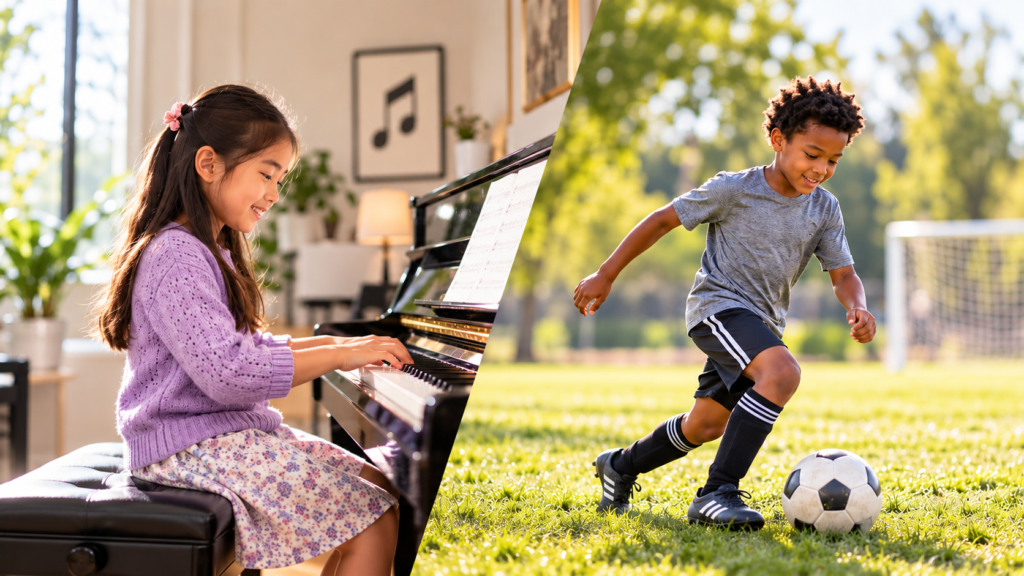
Children don’t have to choose between music and sports when their interests, energy, and schedule can support both. Sports develop physical confidence, teamwork, and the ability to recover quickly after mistakes, while music strengthens sustained attention, listening, memory, patience, and self-expression. The best mix is one your child can enjoy consistently without feeling overscheduled.
Should My Child Do Music or Sports?
Music and sports support different areas of development, so the decision doesn’t have to be either-or. Your child’s interests, needs, and weekly capacity matter more than choosing the activity that looks most beneficial on paper.
This question often comes up when the family calendar becomes crowded. Sports have practices, games, and seasons that feel fixed, while music lessons may appear easier to move or pause. As a result, music is often the first activity to go.
That flexibility doesn’t make music less valuable. In many families, one weekly lesson and a short home practice routine can continue alongside a sport, even when expectations need to be lighter during tournaments or playoff weeks.
What Do Sports Teach Kids?
Sports help children develop physical confidence, teamwork, quick decision-making, and the ability to recover after an immediate setback. They give kids a place to use their bodies with purpose while learning how their choices affect other people.
During a game, children read changing situations, respond to teammates, follow a coach’s direction, and keep going after a missed shot or lost point. Team sports also teach them that different roles can contribute to the same result.
Research suggests that the social side of team sports may be particularly valuable. In a study of more than 11,000 children and adolescents, team-sport participation was associated with 10% lower anxious or depressed scores, 12% lower attention-problem scores, and 17% lower social-problem scores than no sports participation. Because the study was observational, it shows an association rather than proving that sports caused those differences.
What Does Music Teach Kids?
Music develops a slower and more sustained kind of attention. A child learning an instrument has to listen closely, notice small details, coordinate several actions, and repeat a difficult passage without expecting immediate mastery.
Reading notes, following rhythm, remembering what comes next, and controlling the voice or hands give the brain several tasks to organize at once.
In a one-year study of 123 children ages 7 to 11, the music group showed stronger development on a backward digit-span task involving the executive component of auditory working memory. The same difference wasn’t found on the simpler forward digit-span task, which shows why claims about music and cognition should remain specific.
Different instruments also ask children to use these skills in different ways. Piano, violin, and voice each place their own demands on attention, memory, listening, and coordination.
Music also gives children a personal way to express themselves. A child who feels quiet or uncertain on the field may become confident behind a piano, holding a guitar, or singing a song they love.
How Are Music and Sports Similar?
Music and sports use different skills, but both teach children how improvement happens through coaching, repetition, and experience with manageable pressure.
- Regular practice matters more than talent alone. Children improve by returning to the same skills over time.
- Mistakes provide information. A wrong note and a missed shot both reveal what needs attention next.
- Feedback supports progress. Teachers and coaches notice details children may not recognize themselves.
- Confidence follows preparation. Games, recitals, auditions, and competitions become more manageable with experience.
- Progress isn’t always immediate. Both activities teach children to continue when improvement feels slow.
A child who learns to regain focus after a recital mistake may draw on that experience during a game. A young athlete who already understands drills and coaching may bring the same attitude into music lessons.
How Do Music and Sports Develop Different Strengths?
Sports emphasize movement, quick responses, and shared results, while music often emphasizes careful listening, sustained concentration, and individual expression.
| Area | Sports | Music |
| Main effort | Movement and quick decisions. | Listening, coordination, and sustained attention. |
| Feedback | Often immediate and public. | Usually detailed and individual. |
| Progress | Games, drills, times, or scores. | Technique, repertoire, and expression. |
| Social experience | Teammates and shared outcomes. | Lessons, ensembles, choirs, and recitals. |
| Handling mistakes | Recovering while play continues. | Slowing down, correcting, and repeating. |
These differences allow the two activities to complement each other. They give children more than one environment in which to learn, contribute, and feel capable.
How Can You Find the Right Mix for Your Child?
The right mix depends on what your child enjoys, where they currently feel confident, how they respond to pressure, and how much energy they have after school.
Does Your Child Need More Movement or More Quiet Focus?
A child who feels restless indoors may need sports as a physical outlet, with music providing a calmer counterweight. A child who naturally prefers quiet activities may benefit from a recreational sport that gradually develops physical confidence.
Instrument choice can also reflect a child’s energy. Drums, percussion, guitar, and piano all provide physical involvement and immediate feedback. If attention or activity level is part of the decision, consider how different instruments can suit children with ADHD.
How Does Your Child Respond to Competition?
Some children enjoy scoreboards, races, and direct competition. Others find constant comparison stressful.
Music can offer personal goals without removing every form of pressure. Recitals and auditions still challenge children, but progress is usually measured against what they could do a month ago rather than what another child can do today.
Where Does Your Child Get Their Confidence?
When all of a child’s confidence comes from one activity, a difficult season can feel especially discouraging. A second interest gives them another part of themselves to develop.
It can also be healthy for a strong athlete to become a beginner in music, or for an experienced musician to learn a new sport. Both situations teach children how to ask for help and tolerate the early stages of learning.
How Much Energy Does Your Child Have After School?
Available time and available energy aren’t the same. Homework, commuting, sleep, family time, and unstructured play all need space in the week.
One sport and one weekly music lesson may be manageable when two competitive teams aren’t. A sustainable schedule should leave your child with time when no one is evaluating, coaching, or instructing them.
How Can Families Fit Music Lessons Around Sports?
Music and sports are easier to combine when lessons have a consistent weekly place and practice remains short enough to continue during busy weeks.
A few approaches can make the schedule more manageable:
- Choose a lesson time that can stay consistent across sports seasons.
- Use 10 to 20 minutes of focused practice instead of expecting a long daily session.
- Tell the teacher when tournaments, playoffs, or travel weeks are approaching.
- Ask which single practice goal matters most during a crowded week.
- Give recitals the same family support you give games.
- Reassess the schedule whenever a new season begins.
Lesson format matters as well. Group piano and private lessons offer different levels of flexibility, social interaction, and individual pacing, so one may fit an athletic child’s schedule better than the other.
How Can You Tell Whether the Balance Is Working?
A healthy balance leaves your child generally interested, rested, and able to participate without constant conflict at home. Every week won’t be effortless, but exhaustion and dread shouldn’t become the normal pattern.
Signs the balance is working include:
- Your child looks forward to both activities most weeks.
- Practice fits into the week without a daily argument.
- They have enough time for homework, sleep, friends, and rest.
- They can talk about something they’re learning in each activity.
- One difficult lesson or game doesn’t make them want to quit.
The schedule may need adjusting if your child is regularly exhausted, repeatedly misses one activity because of another, or no longer has unstructured time. Changing a lesson time, shortening practice, or choosing a recreational sports program may be enough to restore balance.
Can Music and Sports Both Fit Your Child’s Life?
Your child doesn’t have to build their whole identity on the field or in the music room. When the schedule remains manageable, both activities can give them meaningful but different ways to learn, connect with others, and grow.
The goal isn’t to fill every available hour. It is to find a combination your child can sustain with interest, energy, and enough time to remain a child.
Book a trial lesson to see how music fits into your child’s week, or book a music consultation with James Daly for help choosing an instrument and lesson format.
FAQs
Is Music as Good for Kids as Sports?
Music and sports build different strengths, so neither activity universally replaces the other. Sports provide movement, teamwork, and fast-paced challenges, while music develops listening, sustained attention, coordination, and expression.
Can My Child Do Music Lessons and Sports at the Same Time?
Yes, many children can manage both with one consistent lesson time and realistic practice expectations. The schedule should still leave enough room for homework, sleep, family life, and unstructured play.
Should My Child Stop Music Lessons During Sports Season?
Reducing practice expectations or changing the lesson time may be enough. Continuing at a manageable pace helps preserve skills and routine, although a temporary pause can make sense if your child is consistently overwhelmed.
Which Instrument Works Well for an Athletic Child?
Athletic children often enjoy instruments that feel active and provide immediate feedback. Piano lessons offer visible patterns and clear progress, while guitar, voice, strings, and wind instruments can also be strong choices when the child connects with the sound.
